Case study
HishabKhataহিসাব খাতা
Order intelligence for small e-commerce shop owners, one ledger for every order, every courier and every shop they run.
- Client
- HishabKhata
- Year
- 2026
- Type
- Web platform
- Services
- Web development, Frontend engineering, Backend systems
Overview
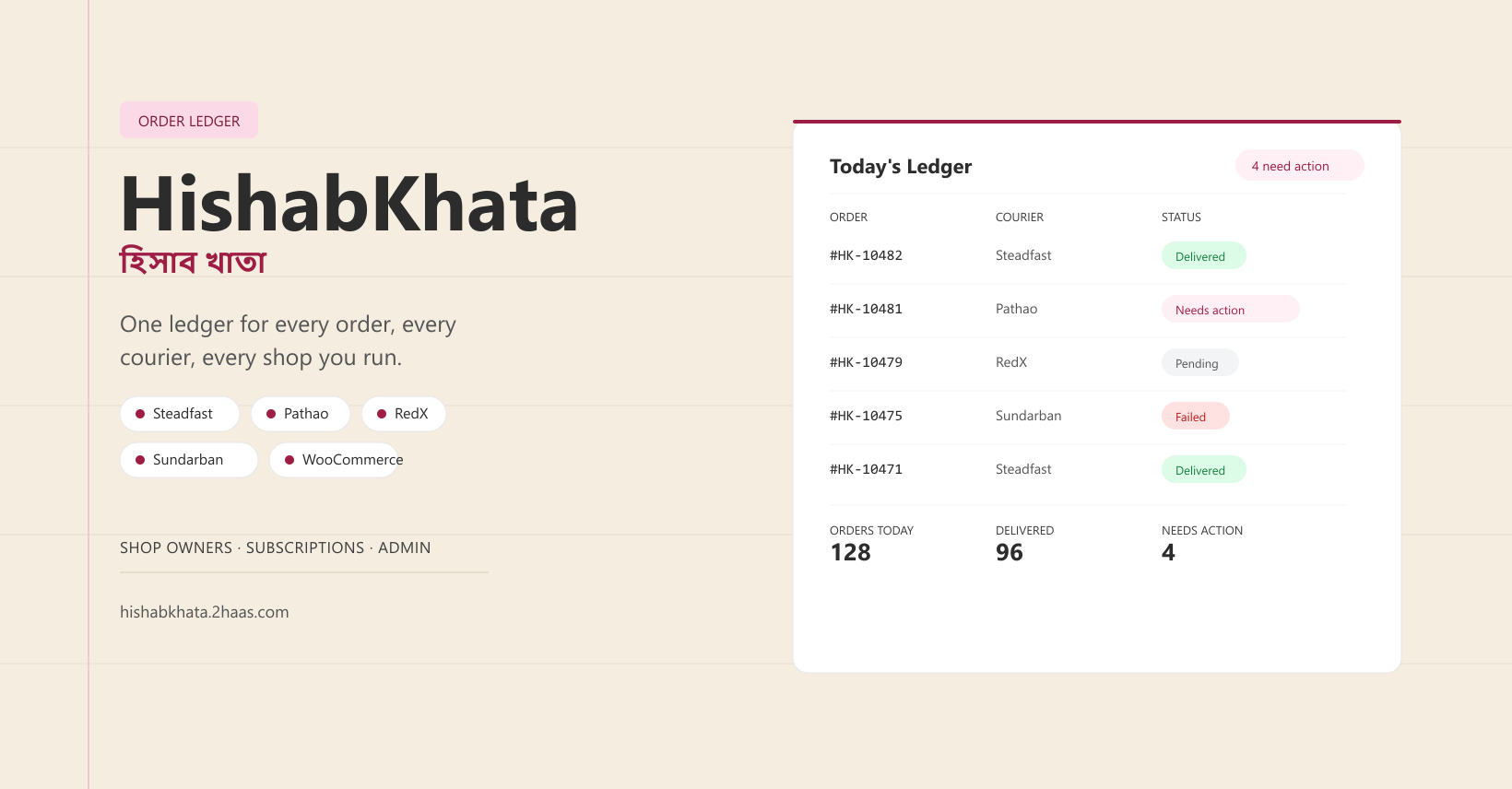
HishabKhata ("account book" in Bangla) connects a shop's storefront and courier accounts into one dashboard, so a small shop owner sees order and delivery status at a glance instead of checking several services by hand.
It syncs orders, products and customers from WooCommerce, tracks delivery status across multiple couriers, and gives admin staff a back-office view to manage shop owners and subscriptions. It's live as a pilot at hishabkhata.2haas.com.
The problem
Small shop owners in Bangladesh run their storefront, two to four courier accounts and a payment gateway as separate logins with no shared view. Answering "did order #1234 get delivered?" or "which orders are stuck with the courier?" means checking each service by hand, often from a phone, between other tasks. Nothing tells them what needs attention right now.
The solution
A single dashboard that pulls the pieces together:
- Shop owners connect their storefront and courier accounts once, then check one screen for order and delivery status, across one or several shops.
- Admins manage shop owners, subscription plans and billing from a denser back-office view, gated by permission rather than all-or-nothing access.
- Superadmins get full platform access by default.
What it does
- Storefront sync. Orders, products and customers import automatically from WooCommerce shops.
- Multi-courier tracking. Delivery status centralized across Steadfast, Pathao, RedX and Sundarban, so a shop owner checks one dashboard instead of four.
- Order intelligence. Pending, failed and action-needed orders surface at a glance, built to stay legible on a budget phone.
- Inventory tracking. Stock levels and stock movements per product and variant, across inventory locations.
- Multi-shop support. Connect and switch between several shops from one account.
- Subscriptions. Tiered plans billed through bKash and Nagad, with payment links and a subscription activation flow.
- API keys. Scoped keys for programmatic access.
- Reports. Cached order, sales and delivery performance reporting.
Tech stack
| Layer | Tools |
|---|---|
| Frontend | Next.js 16 (static export), React 19, TypeScript, Tailwind CSS 4, TanStack Query, Zustand |
| Backend | Ruby on Rails 8.1 (Ruby 4.0) JSON API, Devise + devise-jwt, Pundit |
| Data | PostgreSQL, Redis for cache, jobs and queues |
| Jobs | Sidekiq + sidekiq-cron for courier polling, order import and payment reminders |
| Integrations | WooCommerce, Steadfast, Pathao, RedX, Sundarban, bKash, Nagad |
| Hosting | Cloudflare Pages for the frontend, Docker on EasyPanel for the API and worker |
Design
The interface follows a system called The Ledger: a dense, dependable working document a shop owner opens many times a day, not a dashboard to admire. One Bengali maroon carries every action and status signal against a warm parchment-paper background and graphite text, covering roughly a tenth of any screen outside the login gate, where it's allowed to take over the whole surface. The system deliberately skips the gradient-hero, oversized-stat-tile, glassmorphism look common to AI-generated dashboards, leaning instead toward Linear-style density and restraint. Every screen is designed mobile-first and verified at phone width before it ships, and meets the WCAG AA baseline.
What sets it apart
- One screen, not four logins. Orders, couriers and payments read from a single place.
- Built for the phone it's actually opened on. Density and speed come before visual polish.
- One visual language for two audiences. Shop-owner and admin screens share the same tokens, so switching between them never feels like a different product.