Case study
StudErn
A campus micro-employment platform where students earn through paid tasks and internships, and every finished job becomes a work record the next employer can verify.
- Client
- StudErn
- Year
- 2026
- Type
- Web platform
- Services
- Web development, Frontend engineering, Backend systems
Overview
StudErn connects students and fresh graduates with recruiters through paid short-term tasks, internships and projects. The idea behind it is simple: finished work should become evidence an employer can check, not another claim on a CV.
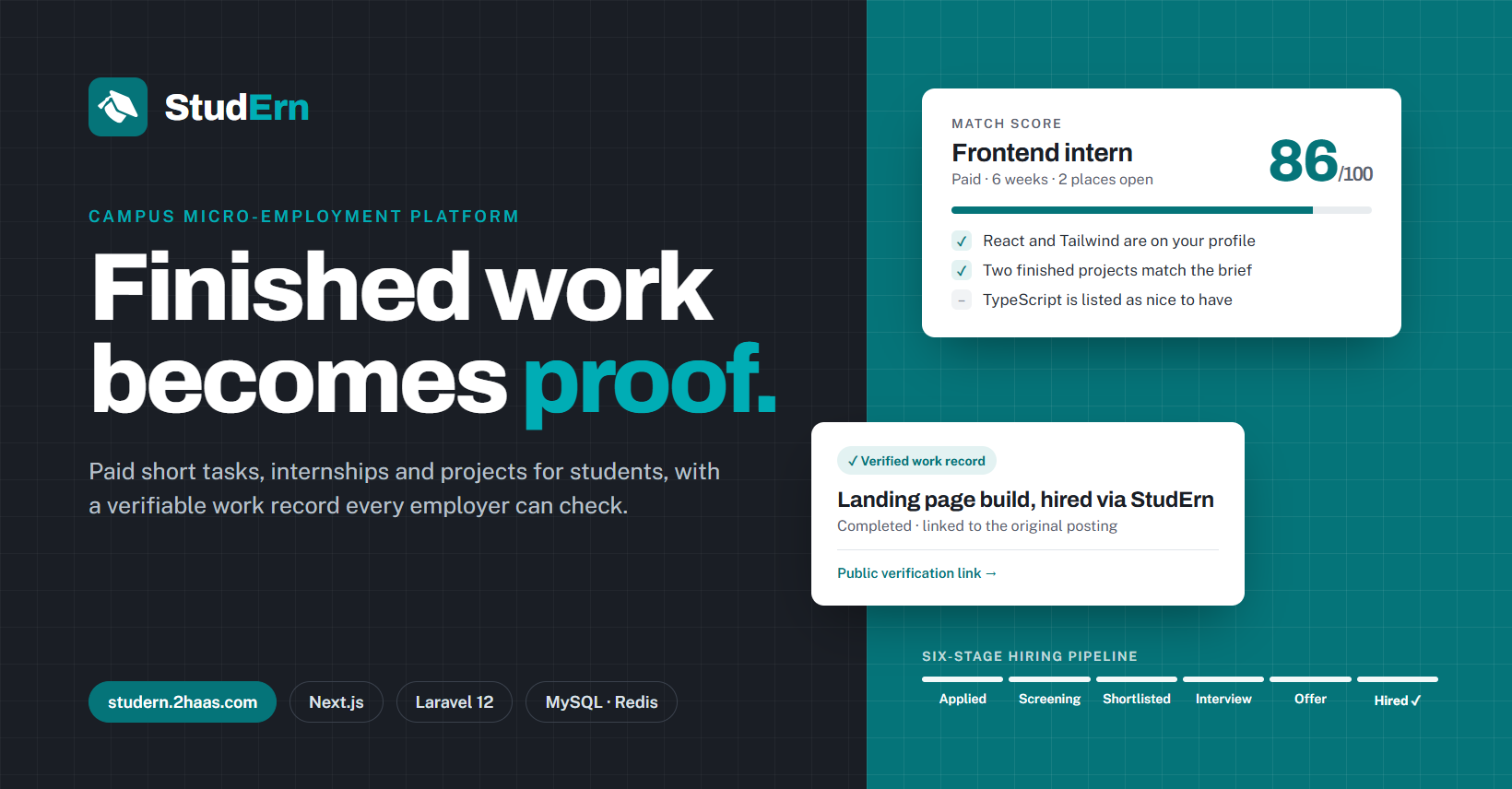
Students build an evidence profile and see a match score for every opening, with the reasons spelled out. Recruiters verify their company, then run their whole selection process on one board. Every hire adds a work record to the student's profile, and a public link lets any employer confirm it.
The platform is live as a pilot at studern.2haas.com.
The problem
Most graduates enter the job market without work experience, and what they learn at university rarely matches what industry does day to day. The gap is about trust as much as skill. An employer can't tell from a degree name or a CGPA what a student can actually do, and a student without a track record can't get the first job that would give them one.
Before writing any code, we ran focus groups and structured interviews with students, academics and industry practitioners, plus a survey of 84 people:
- 76% said lack of real-world experience was a key challenge.
- Fake or exaggerated skills were the top reason employers stopped trusting applicants.
- 49% said they were missing career guidance.
Each of these findings became a requirement.
The solution
A marketplace with three sides that share one system:
- Students find paid work written for people without a track record, apply with their profile instead of a CV, and keep a dated record of everything they finish.
- Recruiters post roles, review what applicants have actually done, and move them through a six-stage pipeline: Applied, Screening, Shortlisted, Interview, Offer and Hired.
- Admins verify companies and moderate postings, users and billing through a privilege-based control panel.
What it does
- Transparent match score. Every opening is scored out of 100 against the student's profile, with plain reasons for each factor and suggestions for in-demand skills. No hidden ranking.
- Verified work records. A hire adds a record linked to the original posting. A public verification link lets any employer check it.
- CV builder without an account. The draft stays in the browser; the server renders an ATS-friendly PDF and stores nothing. After sign-up, the draft imports into the profile without overwriting anything.
- Mock tests. Students book live practice interviews or tests with providers selected by the StudErn team.
- Company verification and teams. Companies are verified before they can post, and several recruiters can share one company account.
- Hiring pipeline. Stage changes, interview scheduling and private notes on one board. A posting closes itself once every place is filled.
- Paid posting packages. The first posting is free. Further packages are paid through bKash, with each payment locked during processing so it can't be charged twice.
- Shareable job links. Job links shared in chat apps and on social media get a proper preview with the job title and image.
- Admin control panel. Live metrics, the selection funnel, demographics, moderation, verification review, billing, discounts and partner companies, each behind its own privilege.
Tech stack
| Layer | Tools |
|---|---|
| Frontend | Next.js 16 (static export), React 19, TypeScript, Tailwind CSS 4, Tiptap |
| Backend | Laravel 12 on PHP 8.3, JWT auth, Laravel Socialite, DomPDF |
| Data | MySQL / MariaDB, Redis for cache, sessions, rate limits and queues, S3-compatible storage |
| Payments | bKash |
| Hosting | Cloudflare Pages for the frontend, Docker on EasyPanel for the API and queue worker |
| Testing | Pest, 922 automated backend tests passing |
Built to be trusted
StudErn handles personal data, job applications and account privileges, so reliability came first:
- Device-bound sessions with JWT, plus sign-in with Google, LinkedIn or GitHub.
- One-time codes to verify email and phone, rate-limited per contact and per IP.
- Role-based access with negative tests that prove one role can't reach another's data.
- Safe deploys. Database migrations only run behind an explicit flag, so restarting a container can never change the schema by accident.
Design
The interface follows a system we call The Quiet Ledger: one deep teal accent, cool blue-grey neutrals, Archivo for headlines and Public Sans for body text. Surfaces are flat and separated by hairline rules. Every screen, from a job card to a privilege-revocation dialog, is designed to read as correct before it reads as attractive. It meets WCAG AA contrast in both light and dark themes, works fully from the keyboard and respects reduced-motion settings.
What sets it apart
- Proof over promises. Employers see finished, dated work, not self-reported skills.
- No black boxes. Students can see exactly why a role matches them and what to learn next.
- Researched before it was built. Every major feature traces back to a finding from students, academics and employers.